ads

Thursday, December 10, 2015

Can Nigeria Replicate China's Economic Transformation as Giant of Africa?

Culled from BBC
A correspondent of the British Broadcasting Corporation, BBC has drawn a comparison between the ailing Nigerian economy and the booming Chinese economy with an advocacy for the former to achieve greatness.
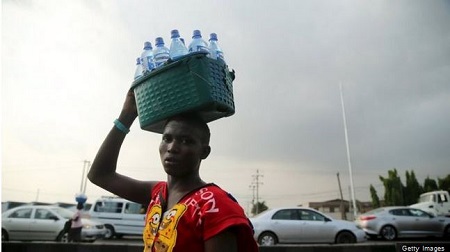
A street hawker in Lagos
China emerged from chaos 35 years ago to become perhaps the largest economy in the world. The BBC's Martin Patience  who has just moved from Beijing to Lagos  asks if Nigeria can do the same.
Swapping Asia's giant for Africa's powerhouse can be a disorientating experience. Leaving Beijing to go and live in Lagos is not a well-worn path. But both Nigeria and China are the most populous countries and biggest economies in their respective continents, making them ripe for comparison.  I feel I've left behind the grey, imposing order of Beijing for the chaos and colour of Lagos, where fun and frustration are doled out in equal measure. Part of the correspondent's condition is that your ears prick up at the slightest mention of a previous posting.  
Imagine my surprise then when, watching last month's inauguration of the new Nigerian cabinet, a remark about the Great Wall of China cropped up during the opening address.
The point, I believe, that the official was trying to make was that the Great Wall was not in itself enough to protect China from invaders,  the government and people need to be incorruptible as well.
I say believe because the audio on the state broadcast briefly cut out. In China, an audio glitch at such an important event would cause heads to roll in shame. In Nigeria, people roll their eyes and shrug it off.
It is just one small example of how the Chinese are known for getting things done, while in Nigeria there is a reputation for cutting corners. Whereas Beijing is a city of smog (the killer downside to the country's breakneck development), Lagos is a city of generators (the sound of a nation failing to realise its economic potential because it can't get its power grid in order).
But when it comes to business, Nigeria and China are alike in one inspiring and infectious way. Both possess an extraordinary entrepreneurial spirit, a can-do-attitude, that if you want to build something you'd better do it yourself.
Street hawkers in Lagos and China share a similar entrepreneural spirit
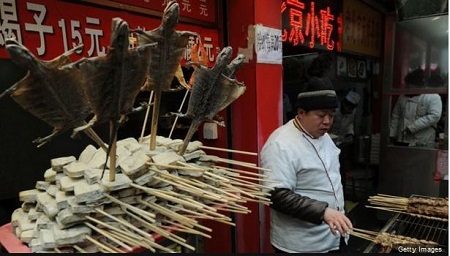
From street hawkers and small shop owners, to CEOs of large companies, people here survive and, occasionally, flourish despite all the obstacles. As for a journalist operating in Nigeria, there is one major difference.
In China, people would shut down at the sight of a foreign journalist, silenced by government repression. In Nigeria, people and politicians don't shut down, they unload.
They talk and talk, and talk some more - they love it. Everyone seems to have an opinion on everything. For a journalist this is both a joy and, as I am beginning to discover, a bit of a nightmare.

In China, people and particularly officials said barely anything, so you would spend hours parsing the meaning. In contrast, in Nigeria you feel you are drowning in information and quotes. Working out what is actually true can be just as time consuming.
When I talk about China to Nigerians, there is an awe and respect that I have heard in many other developing countries about China's remarkable economic achievements in the past three decades.
And, interestingly, while in China the dizzying pace of change has now left many feeling unfulfilled by their material gains, in Nigeria there is a suffocating sense of people wanting meaningful change.
Nigerians want to see infrastructure built, they want better schools and hospitals, and, perhaps, most importantly, they want jobs to better themselves. They want a government that will build and not pilfer.
The Nigerian writer Chinua Achebe once wrote that there was nothing basically wrong with the Nigerian character. The author blamed the country's ills squarely on a failure of leadership.
"The Nigerian problem is the unwillingness or inability of its leaders to rise to the responsibility, to the challenge of the personal example, which are the hallmarks of true leadership," he wrote.
There is now a sense that Nigeria could be at a turning point. Just as 1979 marked the start of China's economic transformation, many Nigerians hope that 2015 will be the beginning of a new era for their country.
They are placing their faith in the former army general they have elected leader, President Muhammadu Buhari. With his no-nonsense style, he has already told his countrymen that they are too "unruly" and need to learn how to queue properly.
In a nation where politicians are notorious for plundering state coffers, Mr Buhari has a reputation for unimpeachable honesty and integrity. People now believe that he will get roads and bridges built (rather than the money being stolen by corrupt officials) which in turn will help get the economy moving.
With almost two million Nigerians entering the job market every year, the country faces a demographic dividend or a demographic disaster. One man is shouldering the expectations of millions.
But can Mr Buhari pull it off? Evidence might suggest otherwise. But then remember China.
Thirty-five years ago the country was emerging from the chaos of the Cultural Revolution. Now, by some estimates, it is the largest economy in the world. With the right leadership, countries can be transformed.
Culled from BBC

When News Breaks Out, We Break In. (The 2014 Bloggies Finalist)

Wednesday, December 9, 2015

Implementation of INDCs: Red Line Africa will not cross in COP 21 Negotiations, according to AMCEN Chair

  PRESS RELEASE

Paris, France 8 December 2015 – The joint Pan African lead institutions brought together African ministers; representatives of their leaders and policymakers to plan the way forward under a new climate change agreement in Paris while upholding Africa’s priorities through regional solidarity on the Intended Nationally Determined Contributions (INDCs) during the 2015 United National Conference on Climate Change in Paris (COP21) Africa Day event today.
The three Pan-African institutions, including the African Union Commission (AUC); the African Development Bank (AfDB); the United Nations Economic Commission for Africa (UNECA) and the NEPAD Planning and Coordinating Agency (NPCA) brought together hundreds of African policy makers and experts attending COP 21 to enlighten them on Africa’s proposed amendments to the draft Paris Agreement (especially Articles on the INDCs) now making its way through the negotiation process.
The Egyptian Minister of Environment, Dr. Khaled Fahmy who currently chairs the African Ministerial Conference on Environment (AMCEN) told the meeting that the provision of means of implementation for the INDCs is a thick red line that Africa will not cross in Paris just because “we want an agreement at all cost.
He said that the other red lines concerned the necessity to have an agreement with a real balance between adaptation and mitigation; while the other is on the legally binding aspect of the expected agreement.
“We are not in Paris to re-write the Convention but to ensure its judicious implementation”, he said, charging that “all African countries having drawn up their different INDCs in accordance with the Peru outcome, the time now is for implementation; and for all to abide by it.
All parties to the COP21 including African countries are expected to express their INDCs—public declarations of post-2020 climate actions they intend to take under a new international agreement to help global mitigation ambitions, as well as adaptation goals within the context of their national priorities, circumstances and capabilities. With INDC submissions to date, global warming is expected to be maintained at 2.7 degrees Celsius, which is above the global ambition of 2 degrees Celsius increase. So far, out of the fifty-four African nations, fifty-three have submitted INDCs.
The day began with an opening session chaired by the Ethiopian Minister of Environment, Forest and Climate Change. The AU Commissioner for Rural Economy and Agriculture, Mrs. Tumusiime Rhoda Peace in her opening statement, stressed that the Africa Day is not about lamenting the risks and challenges posed by climate change, but instead to serve as an opportunity for the continent to showcase to the rest of the world solutions underway to mitigate these challenges, specifically through the development of INDCs.
“The Paris Climate COP is the pinnacle of the global climate change negotiations that has historic milestone from the Africa COP in Durban COP17”. It proofs the level of commitment by the global community in addressing the adverse impacts of climate change and reduction of the greenhouse gases”, she said.  
Mr. Carlos Lopes, Executive Secretary of the UNECA, said that it is important, therefore, that Africa's Parties submission on INDCs lead to the conclusion of a new agreement under the Convention that is in full conformity with its principles and provisions, in particular those of equity and common but differentiated responsibilities and respective capabilities.
“In addition, Annex I Parties need to make “equitable and appropriate” mitigation contributions towards achieving the objective of the Convention taking into account their cumulative historical responsibility and use of atmospheric space and resources and that cumulative emissions in Africa remain extremely low”, Mr. Lopes concluded.
The contributions forthcoming from developed country Parties relating to mitigation, adaptation, finance, technology and capacity are in a balanced manner in the context of a global and comprehensive agreement for the period beyond 2020.
AfDB representative, Anthony Okon Nyong, speaking on behalf of Mr. Akinwumi Adesina, AfDB President noted that “the vision of the African Heads of State and Government to embrace green growth and low carbon development for Africa’s transformation outlined today are meant to propel us into a future which promotes sustainable development for generations to come.”
“Africa has come with solutions on renewable energy; adaptation and loss and damage”, he said.
There were two technical presentations on INDCs by the African Group of Negotiators on Climate Change and the UNECA. A Ministerial dialogue followed on INDCs showcasing Africa’s readiness in addressing climate change, including its ability to deliver on its own potential with international cooperation in addition to the contribution of INDCs to the overall development of the continent. The ministerial dialogue was chaired by H.E Ambassador Ramtane Lamamra, Foreign Minister of Algeria; and vote of thanks was given by H.E Dr. Elham Ibrahim, Commissioner for Infrastructure & Energy, AUC while Ms. Olushola of the AUC served as a Master of Ceremony.
Over 500 participants attended Africa Day, which saw the participation of high level delegates from the governments of Algeria; Cameron, Egypt, Ethiopia, Malawi, Namibia, Niger, Nigeria, South Africa and Uganda, in addition to the African Group of Negotiators on Climate Change, African Union Commission, African Ministerial Conference on Environment, Pan-African Parliament, African Development Bank, East African Community, European Investment Bank, Green Climate Fund, International Labor Organization, NEPAD Planning and Coordinating Agency, Pan African Climate Justice Alliance, United Nations Development Program, and United Nations Economic Commission for Africa.
Throughout the day, leaders discussed the region’s priorities with respect to climate change, while considering the status of INDCs development in Africa and their challenges and opportunities moving forward in implementation.

For more information contact:
Ms. Olushola Olayide, Ag. Head of Division, Environment, Climate Change, Water and Land Management; and AUC focal person to the UNFCCC; African Union Commission; E-mail: OlusholaO@africa-union.org
Media contact and interview request:
Molalet Tsedeke, Africa Union Commission (AUC); molalett@africa-union.org
Penelope Pontet de Fouquieres, Africa Development Bank (AfDB), p.pontetdefouquieres@afdb.org; +33615264061
Jacqueline Chenje, UN Economic Commission for Africa (UNECA); JChenje@uneca.org
Teko Nhlapho; NEPAD Planning and Coordinating Agency (NPCA); tekoh@nepad.org


When News Breaks Out, We Break In. (The 2014 Bloggies Finalist)

Breaking News: Fair Deal Demanded at the Paris Climate Talks

 Kaah Aaron in Paris

Paris- France -- Civil society delegates at the UN climate talks declare that the latest draft of the text failed to live up to promises made by world leaders last Monday. The current draft of the text does not provide the blueprint for a planet where all life can thrive. WHAT: Speak Out by Civil Society in response to text that does not deliver on their demands for a fair deal WHY: The civil society demands that the negotiators commit to creating a binding agreement that is fair for all countries on the planet. This involves that all countries show ambition by drastically reducing pollution rates, that wealthy countries contribute their fair share into the green climate fund, and that developing countries have what they require to adapt to how they are affected by climate crisis.


When News Breaks Out, We Break In. (The 2014 Bloggies Finalist)

Fair Deal Demanded at the Paris Climate Talks

 Kaah Aaron in Paris

Paris- France -- Civil society delegates at the UN climate talks declare that the latest draft of the text failed to live up to promises made by world leaders last Monday. The current draft of the text does not provide the blueprint for a planet where all life can thrive. WHAT: Speak Out by Civil Society in response to text that does not deliver on their demands for a fair deal WHY: The civil society demands that the negotiators commit to creating a binding agreement that is fair for all countries on the planet. This involves that all countries show ambition by drastically reducing pollution rates, that wealthy countries contribute their fair share into the green climate fund, and that developing countries have what they require to adapt to how they are affected by climate crisis.


When News Breaks Out, We Break In. (The 2014 Bloggies Finalist)

COP 21: Climate Change Campaigners Demand Paris to Keep Fair Deal

 By Kaah Aaron in Paris


As the negotiators of the Paris climate deal got to work today a series of outdoor events were staged to bring their attention to the obligations of striking an equitable and ambitious climate deal on Paris
A campaign calling itself  “keep it safe do your share” urged  industrialized countries and big manufacturing companies to rethink their strategists and to help the world deal with the impacts of climate change rather than the horse trading that has existed  over heels of the climate change negotiations in the past. “We want France to be fair and to end this climate dead luck for the good of humanity” the campaigners chanted.
Animated by youths from mostly the global South, the gear of this campaign called on the COP21 negotiators and the world leaders to respect the Intended Nationally Determined Contributions INDCS for each country according to their capabilities and vulnerabilities in a bid to strike a meaningful deal at the end of this Paris rendez vous . 
Maria Alenjandra of the Peru Women Environment and Development Organization told the press and PAMACC that differentiating responsibilities in the drawing up of a climate agreement was a stepping stone on to recognizing the disparities caused by climate change   in the world.  “The world needs a common attention and responsibility to these issues “Maria said.
These campaigners added that it was their priority  to see  world leaders and those in authority holding to a fair  climate deal.  “We must see justice done   without compromise” Maria and her colleagues remarked. These youths took time off citing Floods, weather events, sea rise, and loss of bio diversity in the global south as impediments to the development of not only the youths but vulnerable groups around planet earth.
Yaris Aldi who represented Africa from the Angolan youth organization cited the shrinking of the lake Chad river basin and the unseasonal rainfall patterns as the consequences  of the climate change. In Yaris words, Africa was hit the hardest and needed compensations to cope. “This is why this campaign is about a shared distribution of responsibilities” He added. 
The placards displayed ran messages like the future of development is in risk if heavy polluters do not compensate for the damages they have caused the developing countries.

When News Breaks Out, We Break In. (The 2014 Bloggies Finalist)

Agreeing on 1.5*C is Establishing ClimateJustice on Cop 21. Human Rights Observers say

 By Kaah Aaron in Paris

The International Youth and Students’ Movement of the United Nations(ISMUN) in collaboration with the Pan African Climate Justice Alliance (PACJA)have noted that world leaders will be held accountable if the 1.5*C target is not signed on Paris.
Holding under the theme “Leaving No one behind and Establishing Climate Justice”as one of the side events in this ongoing climate change arrangement, Budi Tjahjono advocacy officer for a Voice at the United Nations lamented that a 1.5*C temperature rise will make more suffers in the poor regions of the world like Africa, the Caribbean’s and Latin America where people depended on natural resources for hope more desperate. He argued that the US position of blocking the use of a human rightslanguage in the drafted agreement had serious consequences for humanity. “An aspect of human rights in the agreement   calls for a historic responsibility and engagement with the rich countries which has much to do with compensations” Budi argued.
Calling for human rights to be put on the center of the discussions, Budi stressed that this could assist government s and member states under this treaty to act accordingly. Speaking for the Caribbean Youth Environment Network Dickson Barry saidtheir youth Movement was advocating for a 1.5*C temperature fixing agreement to be finalized on Paris. According to Barry nothing less than that, was like “putting a gun to their heads”. This youth leader said 1.5 *C for all the 800 youths in the 50different states in the Caribbean meant justice and staying alive. “We want a world that we will inherit and hand to posterity”. Barry added. Weeping that the Caribbean would be at risk if global warming wasn’t checked, Barry cited sea rise and floods as the existing daily challenges that people of his region had to gamble with. “Anything above 2*C is not agreeing at all and we will hold our leaders accountable”. Barry believed. Barry took the liberty to call on governments in the world to create enabling structures for the youths to engage in climate change discussions.
Cooperation Jackson a local coalition for the people of the Africa decent form the USA wondered why the negotiators were putting trade and politics first in the heart of the negotiation process. Explaining how the USA was selfishly trying to control the way people were living on earth, Cooperation Jackson said many cities in the US will be underwater in 2020 if real measures were not taken to address global warming. “1.5*C is relevant even for the US people” Jackson remarked. While calling on members of the global civil society movements to look beyond this particular Cop and for what the future holds , He concluded that the US government didn’t have humanity at heart if it resisted   to append a 1.5*Csettlement on Paris. “We have to speak out for this is an issue of social injustice “. Jackson added.
Speaking from an African civil society perspective, SamsonSamuel Ogallah andShaddadMuawia of Pan African Climate Justice Alliance PACJA  said if the temperature rise exceeded 1.5*C more people in Africa would be left behind in the execution of the SDG’s Sustainable Development Goal’s, “A setback for the development and progress of Africa and more and more people in the troubles of climate change impacts would face moredaring challenges as a result of temperature rise”Ogallah Said. Adding that climate justice meant that the vulnerable in the world received compensations Shaddad expressed disappointments that the US and other industrialized countries were playing to the gallery. “There is need to have a human rights council and reporter who will formulate legal instruments on which states must act”.Shaddad demanded.
Accepting that Justice means human rights Jan Lonn, the   secretary general of the International Youth and Students Movement for the United Nations requested that climate change had to be approached from a human rights perspective. “Article II and the preamble of the Draft carry issues of human rights and must be considered”. He said. Asking for the legalization of a 1.5*C agreement to be declared for the survival of mother earth, JanLonn noted that enacting a 2*C pact was not agreeing at all on Paris. “Our message is clear- signing a 1.5*C treaty is respecting our human rights and justice for all.” Jan ended.


When News Breaks Out, We Break In. (The 2014 Bloggies Finalist)

COP21: Launch of the Africa Renewable Energy Initiative

 PRESS RELEASE

 
Paris, France, 09 December 2015- The Africa Renewable Energy Initiative was launched at a Session during the High-Level Meeting on “Lima-Paris Action Agenda: Focus on Energy” on 07 December, 2015 at the COP21. The Africa Renewable Energy Initiative (AREI) aims to add an additional 10 GW and 300 GW of renewable energy capacity to the African energy sector by 2020 and 2030, respectively, and is endorsed and supported by the Governments of France, Germany, U.S., and Canada.
The High-Level Meeting was organized by the International Renewable Energy Agency (RENA) and the Sustainable Energy for All. The Session of the launch of this Initiative was attended by High-Level representatives of Government and International Organizations including African Ministers from Egypt, Nigeria, Benin, Senegal, Cameroun, Kenya, and Madagascar. Ministers from France, Germany, UK, Italy, Spain and Canada also attended the Session. H. E. Dr Khaled Fahmy, Minister of Environment of the Arab of Egypt and the Chair of AMCEN and H.E. Dr. Elham Ibrahim, Commissioner for Infrastructure and Energy at the African Union Commission, delivered keynote speeches at the opening of the Session.
In his Speech, H.E. Dr. Fahmy welcomed the Africa Renewable Energy Initiative and stated that it represented a landmark opportunity to move forward Africa’s sustainable energy development agenda. Mr. Fahmy further stated that the AMCEN and the Government of the Arab Republic of Egypt will work together with all African Member States and stakeholders to ensure that the objectives of this Initiative are fully implemented in Africa.
Dr. Ibrahim, in her speech also welcomed this Initiative and re-iterated the commitment of the African Union Commission to support initiatives aimed at developing renewable energy and other modern energy sources in Africa. She pointed out that the implementation of this initiative will accelerate already on-going efforts to provide modern and sustainable energy access to all Africans. Dr. Ibrahim called on all stakeholders and Member States to leverage the opportunities provided by the Africa Renewable Energy Initiative and continue to harmonise their efforts and mobilize the required financial and technical resources needed to achieve Africa’s energy access Agenda. “We will work hard to support and see the success the African Renewable Energy Initiative and also call upon all stakeholders including Member States, financial institutions, the private and public sectors, civil societies and research institutions, amongst others, from all parts of the world to join us in our endeavours”, she Stated.
The Launch Session also included Signature Ceremonies; where H.E. Neven Mimica, European Commissioner in charge of International Development and Cooperation and other European countries signed on stage joint Declarations for Sustainable Energy for All in Africa with African Partners. The signings included: (1) Nigeria with France, Germany, Italy, UK and Spain; (2) Benin with France; (3) Senegal with France and Germany; (4) Cameroun with France; (5) Kenya with France, Italy, the Netherlands and the US; (6) Madagascar with France and Germany.

For more information contact:
Mr. Atef Marzouk,
Ag. Head of Division, Energy; Department of Infrastructure and Energy, African Union Commission; E-mail: MarzoukA@africa-union.org

Media and interview contact:


When News Breaks Out, We Break In. (The 2014 Bloggies Finalist)

COP 21: African Civil Society Group Doubles Efforts for Ecological Justice, New Binding Protocol

 By Kaah Aaron in Paris

African civil society groups under auspice of Pan African Climate Justice Alliance (PACJA) have tasked all stakeholders as the conference enters into the final hours of negotiation at the Paris climate conference to ensure that a comprehensive, fair, ecologically just and legally binding agreement for a new treaty is delivered by the end of this week as anything less will be unacceptable to the long-suffering people of the continent of Africa. “The present reality at the conference confirms that countries have spent the first week restating their old positions leaving most of the key debates unresolved,” Sam Ogallah says. Ogallah who is of the Pan-African Climate Justice Alliance (PACJA) further called on Ministers to urgently inject energy into the process this week so that the agreement is fair enough reflecting the principle of CBDR and addresses the issues of loss and damage, finance for adaptation and mitigation and keeping the global warming well below 1.50C. Africa welcomes the current pledges made to the GCF by Paris, Vietnam and Norway, but this is not enough -- particularly from the adaptation point of view. The total amount in the GCF so is far is even too little for adaptation actions in Africa alone given the latest estimates of the UNEP Adaptation Gap Report, which says that costs for adaptation alone could rise to a level of 100 to 200 billion dollars per year in 2050 even if the 2 degree limit is kept. According to Azeb Girma of LDC Watch “there is serious need for financial support for adaptation in African countries, therefore GCF pledges need to increase. For the 2020 goal of 100 billion dollars per year, Paris is yet to make any serious progress on clarifying a pathway to achieve it.” Additionally, the question of how climate finance can be scaled up predictably after 2020 remains unresolved with some developed countries obstructing discussions of a post-2020 pathway,” Azeb, added. “The time for posturing and sloganeering is over; it is time to make a deal. Paris may be the last chance we have to break the standoff that has prevented adequate climate action for decades. Negotiators can make history this week, but it is up to them to lead and not to fail,’ Rebecca Muna of ForumCC, Tanzania declared. “Among the burning issues at the core of the negotiations are how the agreement will differentiate between countries to determine their responsibility to act, how country’s initial commitments will be assessed for their adequacy and fairness, how financial support for poor nations will be included in the new agreement, and how developed countries will meet their promise to mobilize $100 billion by 2020 in funding to support climate action in poor countries,” Augustine Njamnshi from BCDP, Cameroon and Technical/Political Affairs Chair of PACJA said. African groups at the conference believes that countries must agree to phase out fossil-fuel emissions to zero and lead the world to a renewable energy future if the Paris treaty is to make a difference. Actions on adaptation and compensation for loss and damage must be addressed with regard to their true scale and be at the core of the Paris agreement. The businesses causing the problem must be held accountable and victims of their dirty actions must be duly compensated.


When News Breaks Out, We Break In. (The 2014 Bloggies Finalist)